Introduction
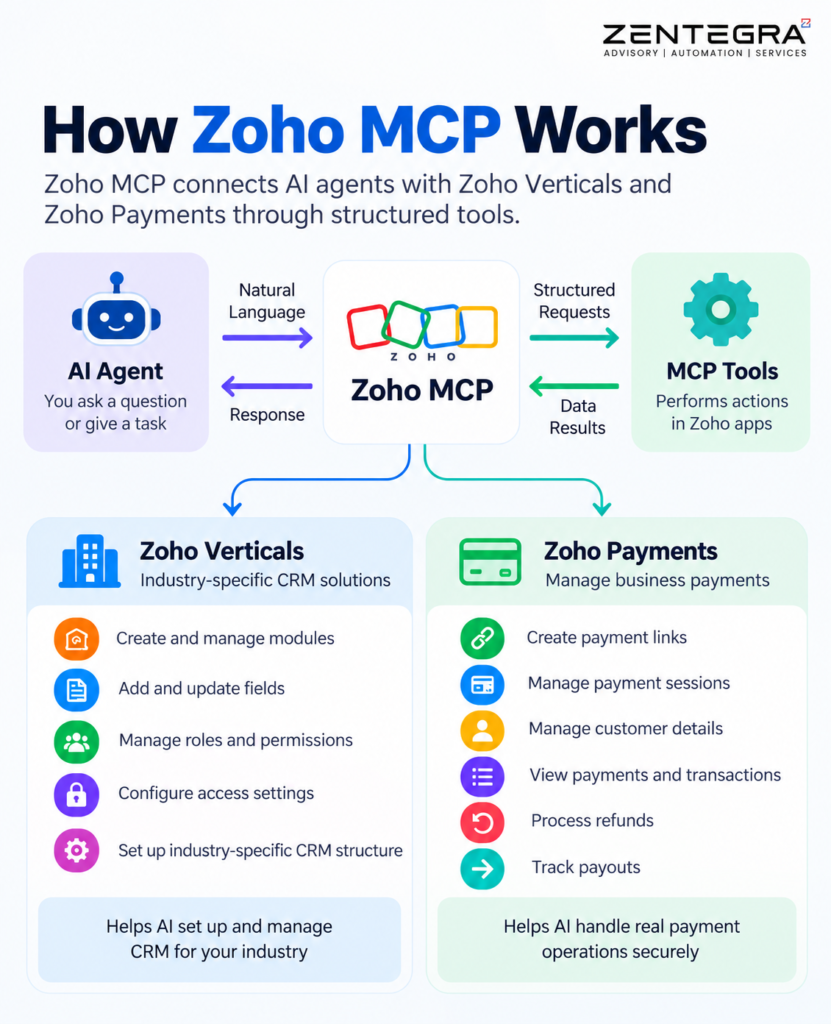
Zoho MCP is becoming more than a way for AI to read business data. With the addition of Zoho CRM for Verticals and Zoho Payments, AI agents can now work with CRM architecture and payment operations through structured tools. That means businesses can move from simply asking AI for information to using AI to configure systems, create payment links, retrieve transactions, manage refunds, and track payouts.
Zoho MCP uses the Model Context Protocol (MCP), an open protocol that allows AI applications to interact with business software through defined tools. Zoho provides the infrastructure for creating MCP servers and connecting Zoho and supported third-party services to AI clients.
For businesses, this creates an important opportunity: CRM, industry-specific workflows, and payment systems integration can work together in a single AI-driven workflow.
What Is Zoho MCP?
MCP acts as a bridge between an AI agent and business applications. Instead of requiring an employee to open several dashboards, find a record, create a payment link, and check a payout manually, the AI agent can use configured MCP tools to perform supported actions.
Zoho MCP lets organizations create MCP servers and configure tools from Zoho and third-party services. Zoho states that its MCP ecosystem includes hundreds of MCP-ready applications, while access remains controlled by the tools configured on each server.
For example, a business could create a workflow such as:
Customer request → CRM record → payment link → payment status → refund or payout check
The value is not simply automation. It is the ability to connect several business actions through natural-language instructions while keeping the underlying operations structured and permission-controlled.
How Zoho MCP Enhances Zoho Verticals
Different industries rarely use a standard CRM structure. A real estate company may need properties, agents, buyers, and site visits. An automotive business may need dealers, vehicles, customers, and service records. A financial services company may require industry-specific customer and transaction information.
This is where Zoho CRM for Verticals becomes important.
Zoho describes CRM for Verticals as an industry-specific platform that helps businesses and partners build, deploy, and manage customized CRM applications. Its vertical solutions cover areas such as automotive, life sciences, financial services, real estate, retail, insurance, hospitality, education, services, startups, broadcasting, and agencies.
With the Verticals toolset available through Zoho MCP, AI agents can work with important CRM configuration tasks, including:
- Creating and managing custom modules
- Creating and updating fields
- Retrieving module and field metadata
- Creating and managing roles
- Managing profile permissions
- Configuring access-related settings
Zoho’s announcement explains that these capabilities allow an AI agent to help establish and maintain CRM architecture without requiring users to navigate multiple CRM administration screens manually.
Why This Matters for Businesses
Imagine a company launching a new business division. Instead of manually creating modules, fields, roles, and permissions one by one, an authorized AI workflow could assist with setting up the required CRM structure.
The key advantage is speed. The second advantage is consistency.
However, businesses should not treat AI-generated CRM configuration as a replacement for governance. CRM architecture still needs human review, especially when businesses are planning a structured Zoho CRM implementation that affects access permissions, sensitive customer data, or important business processes.
Zoho Payments Brings Real Payment Actions to MCP
The biggest change is arguably the addition of Zoho Payments.
Zoho Payments is designed to manage business payment operations, including online payment collection, payment links, invoices, subscriptions, ecommerce checkout, and related payment activities. In India, Zoho Payments supports methods including UPI, cards, net banking, wallets, and bank transfers, subject to the applicable product and payment-method availability.
Through the Zoho Payments MCP Server, AI clients can access configured payment tools for actions such as:
Payment workflow | Example MCP capability |
Payment sessions | Create or retrieve payment sessions |
Payment links | Create, update, retrieve, or cancel links |
Customer management | Create or retrieve customer details |
Payments | List or retrieve payment information |
Refunds | Create and retrieve refunds |
Payouts | Retrieve payouts and payout transactions |
These capabilities are documented by Zoho’s Payments developer documentation.
This changes the role of AI from an information assistant into a potential business operations interface.
For example, an authorized user could ask an AI client to create a payment link for a customer, retrieve today’s payments, check a payout, or initiate a refund. The MCP server maps the request to the appropriate configured tool and returns the result.
Combining Zoho Verticals and Zoho Payments
The real opportunity appears when these two capabilities are combined.
Consider a training business that creates a custom CRM module for corporate clients. The workflow could potentially connect:
Lead → Customer → Industry-specific CRM record → Payment link → Payment received → Payout tracking
For a subscription business, the workflow could similarly connect customer information with payment operations and follow-up processes.
This is where payment systems integration becomes more valuable. Add after this sentence: “Businesses can also use Zoho Flow for business automation to connect applications and automate information between systems.
Zoho itself gives the example of combining CRM setup with payment operations—for instance, creating a custom CRM structure and then generating payment links and tracking transactions as part of an end-to-end workflow.
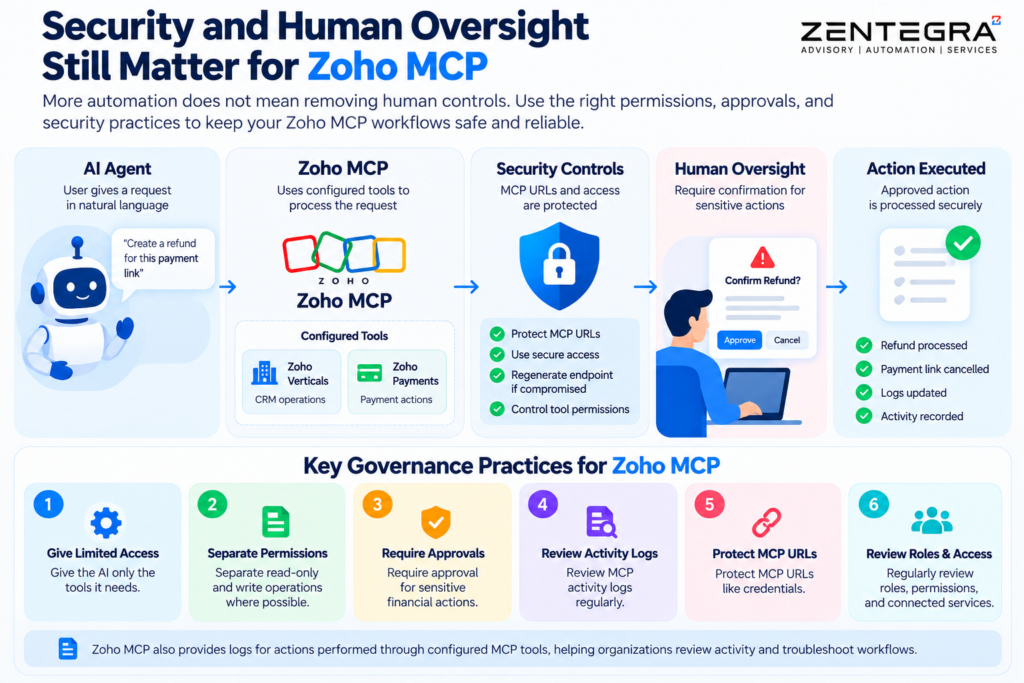
Security and Human Oversight Still Matter
More automation does not mean businesses should remove human controls.
Zoho MCP uses configured tools to determine what an AI client can do. Zoho also recommends protecting MCP URLs because they provide access to the configured services. If an MCP URL is compromised, Zoho provides an option to regenerate the endpoint.
For payment workflows, organizations should consider a human-confirmation step before high-impact actions such as refunds or payment-link cancellation. Zoho’s Payments developer documentation specifically recommends human confirmation before executing actions and warns that AI agents can combine tools across integrations.
A practical governance model should include:
- Give the AI only the tools it needs.
- Separate read-only and write operations where possible.
- Require approval for sensitive financial actions.
- Review MCP activity logs.
- Protect MCP URLs like credentials.
- Regularly review roles, permissions, and connected services.
Zoho MCP also provides logs for actions performed through configured MCP tools, helping organizations review activity and troubleshoot workflows.
What Indian Businesses Should Know About Compliance
Payment automation in India needs more than technical integration.
Zoho Payments states that its Indian operations function under the Reserve Bank of India’s regulatory framework and that Zoho Payments is authorized as a Payment Aggregator for online and physical transactions.
Businesses using payment workflows should also understand the broader regulatory environment. RBI’s payment framework covers areas such as merchant onboarding, customer grievance handling, dispute management, security, fraud prevention, and risk management. The RBI’s 2024 cyber-resilience directions for non-bank Payment System Operators also address areas including API security, data security, access control, incident response, cloud security, and vendor risk.
Data protection is another important consideration. India’s Digital Personal Data Protection Act, 2023 provides the core framework for processing digital personal data, while the Digital Personal Data Protection Rules, 2025 were notified in November 2025 with phased commencement provisions.
For businesses, the practical lesson is simple: AI automation should operate within the organization’s existing privacy, security, payment, and access-control framework as part of a broader Zoho automation strategy for business growth.MCP does not remove those obligations.
Zoho MCP vs Traditional API Automation
Traditional API integration remains useful, particularly for highly controlled and deterministic processes. MCP adds another layer by allowing AI agents to discover and invoke configured tools using natural language.
The difference can be summarized simply:
Traditional API approach | Zoho MCP approach |
Developer defines API calls | AI selects configured tools |
Usually code-driven | Natural-language interaction |
Strong deterministic control | Flexible agent-driven workflows |
Requires integration development | Reduces some integration complexity |
Best for fixed processes | Useful for dynamic AI workflows |
This does not mean MCP replaces APIs. In many cases, MCP works on top of the existing application capabilities and APIs. Zoho confirms that MCP actions are subject to the standard API limits of the underlying services rather than creating a separate unlimited API quota.
Practical Use Cases for Zoho MCP
Businesses can use Zoho MCP to simplify CRM, payments, and everyday business operations.
1. Industry-Specific CRM Setup
Use AI to help create custom modules in Zoho CRM, fields, roles, and permissions for industry-specific CRM processes through Zoho Verticals.
2. Customer Payment Collection
Create and manage payment links and payment sessions through Zoho Payments, making it easier to collect payments from customers.
3. Payment Monitoring
Quickly retrieve payment, transaction, and payout information through AI-assisted workflows instead of manually searching records.
4. Refund Management
Retrieve refund details and perform supported refund actions through Zoho Payments, with human approval for sensitive financial actions.
5. End-to-End Workflows
Connect CRM and payment activities into one workflow—for example, customer record → payment link → payment received → follow-up.
6. AI-Assisted Administration
Reduce repetitive administrative work by using AI to interact with configured Zoho tools while keeping permissions, security, and human oversight in place.
Frequently Asked Questions
Zoho MCP is Zoho’s implementation around the Model Context Protocol. It allows businesses to create MCP servers that expose configured Zoho and third-party tools to compatible AI clients.
Yes. Zoho Payments has an MCP server that supports configured operations involving payment sessions, payments, payment links, customers, refunds, and payouts.
Zoho Verticals are industry-focused CRM solutions designed for sectors such as automotive, financial services, real estate, retail, education, hospitality, insurance, and other industries.
With the Zoho MCP Verticals toolset, AI agents can perform supported CRM configuration operations such as creating modules, managing fields, and configuring roles and profiles.
Conclusion
The addition of Zoho Verticals and Zoho Payments to Zoho MCP moves AI automation closer to real business operations.
Instead of limiting AI to searching records or answering questions, businesses can use configured AI workflows to help build CRM structures, manage industry-specific data models, create payment links, retrieve payment information, process refunds, and track payouts.
The biggest opportunity is not any single MCP tool. It is the ability to connect multiple business actions into one controlled workflow.
For organizations already using Zoho, this creates a practical path toward AI-assisted CRM administration, payment systems integration, and end-to-end business automation. The businesses that benefit most will be those that combine automation with strong permissions, human oversight, security practices, and regulatory awareness.
For Zentegra, this represents an important direction in Zoho business automation: helping organizations understand not only what AI can do, but how to introduce it into real business processes responsibly, securely, and at scale.