Introduction:
Zoho Inventory MCP is transforming how businesses handle inventory by enabling operations through simple, human-like conversations. Instead of navigating complex dashboards or manual processes, you can now manage stock, track orders, and control warehouse inventory management using AI-powered commands.
This shift is not just about convenience—it’s about speed, accuracy, and smarter decision-making. With the rise of inventory management AI, tools like Zoho Inventory MCP help businesses automate repetitive tasks, reduce errors, and improve operational efficiency.
If you’re new to inventory systems, it’s helpful to start with a complete Zoho inventory management guide to understand how inventory tracking and automation work before exploring MCP.
What is Zoho Inventory MCP?
Zoho Inventory MCP (Model Context Protocol) is an advanced AI-driven layer integrated into Zoho’s inventory platform. It enhances the capabilities of Zoho Inventory management software by enabling users to manage stock, orders, and warehouse operations through simple conversational commands.
Instead of clicking through multiple menus, you can simply ask:
- “What is my current stock level?”
- “Show low-stock items”
- “Create a purchase order for supplier X”
The system understands your intent and executes the task instantly.
This innovation builds on the foundation of modern Zoho inventory management software, making inventory operations faster, smarter, and more accessible for businesses of all sizes.
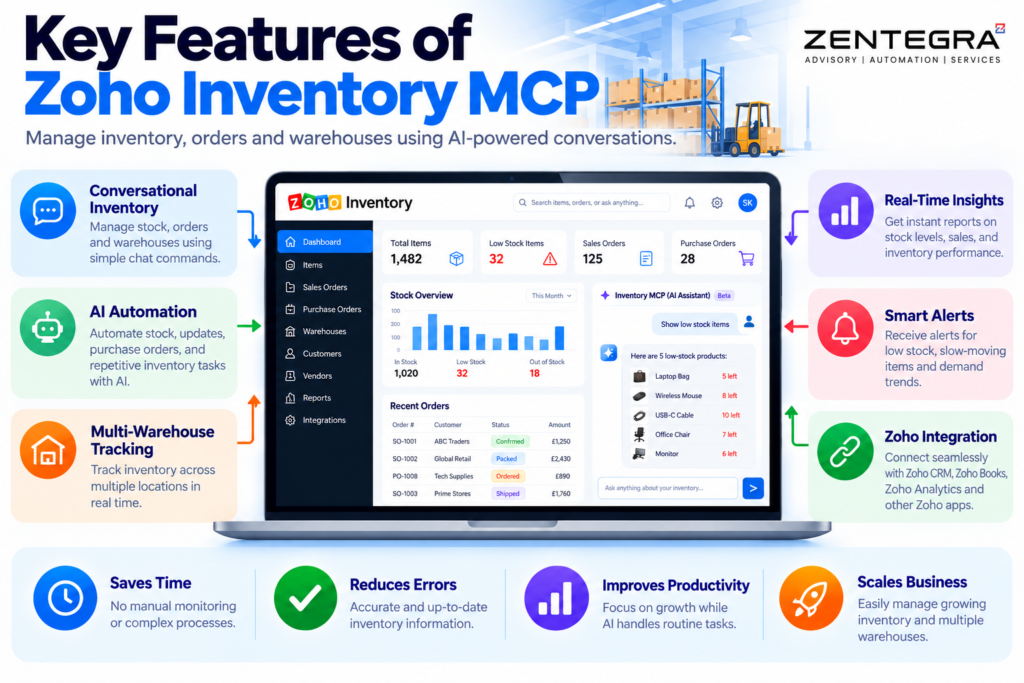
Key Features
Feature | Description |
Conversational Interface | Manage inventory using natural language |
AI Automation | Automates repetitive inventory tasks |
Real-Time Insights | Instant stock updates and analytics |
Workflow Integration | Connects with CRM, finance, and sales tools |
Smart Alerts | Predicts low stock and demand trends |
How Zoho Inventory MCP Works
At its core, Zoho Inventory MCP uses inventory management AI to interpret user commands and translate them into actions within the system.
This process is powered by Natural Language Processing (NLP), which enables systems to understand human language and respond accurately. To understand how NLP powers such systems, refer to IBM’s explanation of natural language processing.
Step-by-Step Workflow
User Input
You type or speak a command like “Check stock for product A.”AI Interpretation
The system understands the request using natural language processing (NLP).Action Execution
It retrieves data or performs tasks within the inventory system.Response Output
You get instant results in a conversational format.
This eliminates the need for technical expertise and reduces training time for employees.
Why Businesses Need Conversational Inventory Management
Traditional inventory systems often depend on manual data entry and constant monitoring. Teams must switch between multiple screens, update stock manually, and generate reports step by step. This process takes time and increases the chances of mistakes, delays, and inefficiencies.
With Zoho inventory management software enhanced by MCP (Model Context Protocol), businesses can manage inventory through simple conversations. Instead of navigating dashboards, users can ask questions or give commands, and the system instantly responds with accurate results.
This modern approach brings several key benefits:
1. Faster Decision-Making
In traditional systems, finding the right information can take minutes or even hours. You may need to check multiple reports or dashboards to understand stock levels or sales trends.
With conversational inventory management, you can simply ask questions like:
- “What is my current stock status?”
- “Which products are running low?”
The system gives instant answers in real time. This speed helps business owners and managers make quick, informed decisions without delays.
2. Reduced Human Errors
Manual data entry is one of the biggest causes of inventory mistakes. Even small errors, like entering the wrong quantity or missing an update, can lead to stock mismatches and financial losses.
Zoho Inventory MCP uses automation to handle tasks such as stock updates, order processing, and tracking. This reduces dependency on manual work and ensures higher accuracy.
As a result, businesses can maintain reliable inventory records and avoid costly mistakes.
3. Improved Productivity
Employees often spend a lot of time on repetitive tasks like updating stock, generating reports, and tracking orders. This reduces their ability to focus on more important work.
With AI-powered automation, these routine tasks are handled automatically. Employees can now focus on strategic activities such as planning, customer engagement, and business growth.
This leads to better use of time and higher overall productivity.
4. Better Customer Experience
Customers expect fast and accurate service. If inventory data is outdated or incorrect, it can lead to delays, order cancellations, or poor customer satisfaction.
With real-time inventory tracking, businesses always have accurate stock information. This ensures:
- Faster order processing
- On-time deliveries
- Fewer stockouts or backorders
As a result, customers receive a smooth and reliable experience, which builds trust and loyalty.
Impact on Warehouse Inventory Management
Warehouse operations are complex. Managing stock across multiple locations can be challenging.
Zoho Inventory MCP simplifies warehouse inventory management by:
- Tracking stock across warehouses in real time
- Automating stock transfers
- Providing instant inventory insights
- Predicting demand trends
For businesses dealing with multi-location stock, this detailed guide on inventory management for ecommerce and multi-warehouse solutions explains how to effectively track inventory across warehouses.
Example Use Case
A warehouse manager can simply ask:
👉 “Which products are running low in Warehouse 2?”
The system instantly provides a list, saving hours of manual work.
Zoho Inventory MCP vs Traditional Inventory Systems
Aspect | Traditional Systems | Zoho Inventory MCP |
User Interface | Complex dashboards | Simple conversation |
Speed | Manual navigation | Instant responses |
Accuracy | Error-prone | AI-driven precision |
Training | Requires training | Easy to use |
Automation | Limited | Advanced AI automation |
Real Business Benefits
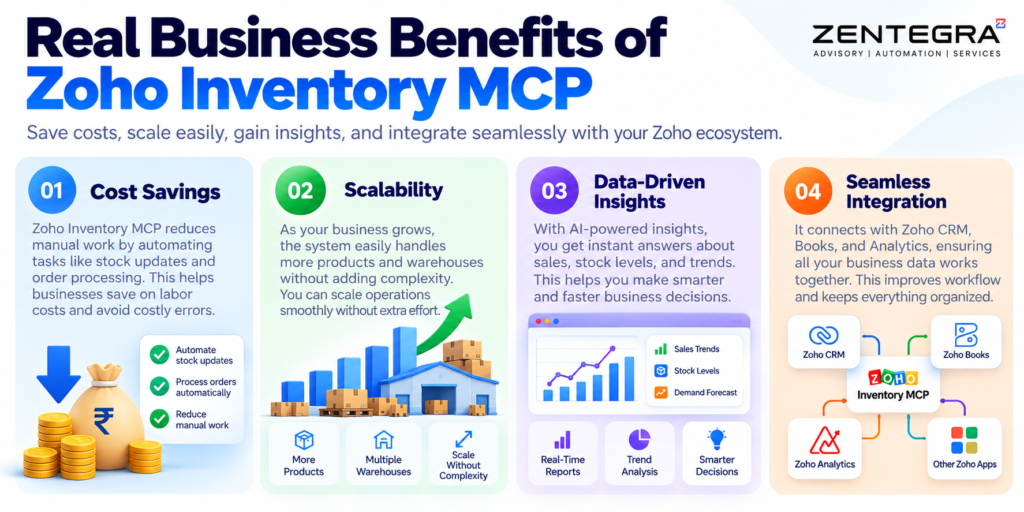
1. Cost Savings
Zoho Inventory MCP reduces manual work by automating tasks like stock updates and order processing. This helps businesses save on labor costs and avoid costly errors.
2. Scalability
As your business grows, the system easily handles more products and warehouses without adding complexity. You can scale operations smoothly without extra effort.
3. Data-Driven Insights
With AI-powered insights, you get instant answers about sales, stock levels, and trends. This helps you make smarter and faster business decisions.
4. Seamless Integration
It connects with Zoho CRM, Books, and Analytics, ensuring all your business data works together. This improves workflow and keeps everything organized.
Use Cases Across Industries
E-commerce
- Manage large product catalogs
- Track orders in real time
- Reduce stockouts
Retail
- Monitor store-level inventory
- Automate restocking
- Improve customer satisfaction
Manufacturing
- Track raw materials
- Optimize production planning
- Reduce waste
Is Zoho Inventory MCP Suitable for Indian Businesses?
Yes. Indian businesses benefit significantly from this system, especially with:
- GST-compliant invoicing
- E-invoicing integration
- Multi-warehouse management
- Real-time stock tracking
With increasing compliance requirements under GST laws, automation ensures accuracy and reduces penalties.
How Zentegra Helps You Implement Zoho Inventory MCP
At Zentegra, we help businesses unlock the full potential of Zoho inventory management software by:
- Customizing workflows
- Setting up automation
- Integrating with other Zoho apps
- Training teams for adoption
Our expertise ensures a smooth transition to AI-powered inventory systems.
Best Practices to Get Started
To maximize results with Zoho Inventory MCP:
- Start with clear inventory workflows
- Automate repetitive tasks
- Use real-time analytics for decisions
- Train your team on conversational commands
- Integrate with CRM and accounting tools
Future of Inventory Management AI
The future is conversational, predictive, and automated.
With tools like Zoho Inventory MCP:
- AI will predict demand more accurately
- Inventory systems will become self-managing
- Businesses will rely less on manual processes
This shift will redefine how companies handle operations.
Frequently Asked Questions (FAQs)
You can track inventory in Zoho Inventory by adding your products, setting stock levels, and enabling real-time tracking. The system automatically updates stock when you create sales orders, purchase orders, or invoices. With Zoho Inventory MCP, you can also check stock levels using simple commands like “Show current stock” or “List low inventory items,” making tracking faster and easier.
Yes, Zoho is an Indian-founded company with its headquarters in Chennai, Tamil Nadu. It also has a global presence with offices in multiple countries. Zoho is known for building its own technology stack and supporting businesses worldwide while maintaining strong roots in India.
Zoho MCP (Model Context Protocol) is part of Zoho’s AI-driven capabilities and may not always be available as a completely free feature. Access depends on the Zoho plan or services you are using. Some basic features may be included, while advanced AI capabilities could be part of premium plans or future updates.
Conclusion
Zoho Inventory MCP is not just an upgrade—it’s a complete transformation in how businesses manage inventory.
By combining inventory management AI, automation, and conversational interfaces, it simplifies complex processes and improves efficiency across the board.
For businesses aiming to scale, reduce errors, and improve decision-making, adopting this technology is no longer optional—it’s essential.
With the right implementation partner like Zentegra, businesses can seamlessly adopt Zoho Inventory MCP, unlock its full potential, and build smarter, more efficient inventory operations for long-term growth.