Implementing Zoho yourself can look simple at first. You create an account, choose applications, configure fields, build workflows, and start adding data. But once your business needs multiple applications, custom automation, integrations, or historical data migration, the project becomes much more complex.
That is where a Zoho Advanced Partner can make a meaningful difference.
A qualified partner can help you map business processes, configure the right Zoho applications, build automation, migrate data, test workflows, train users, and provide support after launch. Instead of simply setting up software, the goal is to build a system that fits how your business actually operates.
That is where a Zoho Advanced Partner can make a meaningful difference. A qualified partner can help you map business processes, configure the right Zoho applications, build automation, migrate data, test workflows, train users, and provide support after launch. At Zentegra, we help businesses build connected Zoho solutions around their operational needs rather than simply configuring software.
Zoho itself offers a broad ecosystem of business applications. For businesses considering a connected approach, Zoho One’s business ecosystem currently brings together more than 45 applications covering areas such as sales, marketing, finance, HR, support, analytics, and business operations. , while its partner programs provide businesses with access to professionals who can help with implementation and related services. Zoho’s partner programs include Authorized, Advanced, and Premium tiers, with Premium being the highest tier.
What Is a Zoho Advanced Partner?
A Zoho Advanced Partner is a business operating within Zoho’s partner ecosystem at the Advanced tier. The designation should be viewed as one factor when evaluating a service provider, not as a substitute for checking the partner’s actual experience, certifications, implementation methodology, product knowledge, and customer support.
Zoho’s partner ecosystem supports services around implementation, customization, training, and business solutions. Businesses evaluating a partner can also review Zoho’s partner tiers and evaluation criteria to understand how Zoho structures its partner program and how customers can use partner profiles, certifications, and case studies during their evaluation. For example, Zoho’s Books partner program requires aspiring partners to complete training and certification before becoming certified partners.
Advanced Partner vs Certified Zoho Partner
When comparing providers, businesses should therefore look at what a Zoho Advanced Partner can deliver in practice, rather than relying only on the partner designation.
A certified Zoho partner demonstrates relevant training or certification within Zoho’s ecosystem. An Advanced Partner refers to a partner tier within Zoho’s partner program.
Therefore, when choosing a provider, look beyond the badge. Learn how to choose the right Zoho consulting partner by evaluating factors such as product expertise, implementation experience, certifications, migration capabilities, and post-launch support.Which Zoho products does the team specialize in?
- How many implementations have they completed?
- Do they understand your industry?
- Can they handle data migration?
- Can they build custom automation?
- What happens after go-live?
For example, Zentegra publicly states that it has a team of certified Zoho professionals and provides implementation and customization services across the Zoho ecosystem.
Why Choose a Zoho Advanced Partner Instead of DIY Implementation?
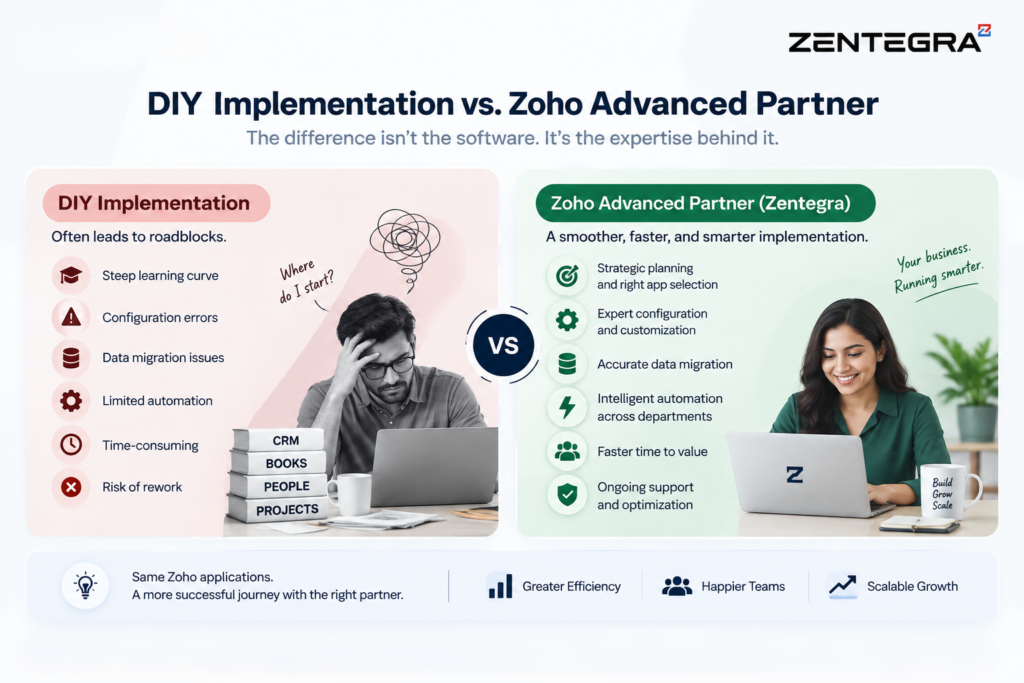
The difference between DIY configuration and working with a Zoho Advanced Partner becomes more noticeable as implementation complexity increases.
Reduce configuration errors
A CRM field, workflow, approval rule, or automation can affect other parts of your system. A small configuration mistake may create duplicate records, incorrect notifications, broken workflows, or reporting problems.
A Zoho Advanced Partner can also bring an established implementation methodology to the project, reducing the amount of time your internal team spends learning through trial and error. Understanding the Zoho implementation process helps businesses see how requirements, workflows, configuration, testing, and deployment fit together. This helps ensure that the technology follows the business process rather than forcing employees to work around the software.
An experienced Zoho Advanced Partner can identify dependencies between applications, workflows, permissions, and integrations before they create problems.
Deploy faster
Learning the platform while simultaneously implementing it can extend the project.
An experienced partner already understands common configuration patterns, integration requirements, migration challenges, and testing procedures. This can reduce the time spent searching for documentation or rebuilding a setup that does not work.
Build around your business processes
Good implementation starts with questions such as:
- How does a lead become a customer?
- Who approves of discounts?
- Where does financial data originate?
- Which tasks should be automated?
- Which teams need access to customer information?
What reports does management need?
This is one reason businesses often work with a Zoho Advanced Partner when their implementation involves multiple departments or connected applications.
Zoho itself recommends documenting expectations and checking factors such as geographical coverage, partnership status, and product certifications when evaluating a partner. Its partner guidance can therefore be useful when comparing providers against your specific business requirements. Zoho’s guidance on working with a partner also provides examples of businesses using partners to connect Zoho applications and adapt the platform to their processes.
This is where Zoho CRM consulting becomes valuable. The consultant can translate business requirements into CRM architecture, workflows, dashboards, permissions, and automation.
Avoid expensive rework
The cheapest implementation is not always the one with the lowest initial cost.
If a DIY setup later needs to be rebuilt because the data model, workflows, permissions, or integrations were poorly designed, the business may pay twice: once for the original setup and again for the correction.
What Does a Zoho Consulting Partner Actually Do?
A Zoho consulting partner focuses on the connection between business requirements and technology.
The process typically starts with discovery. The consultant identifies current processes, bottlenecks, applications, data sources, and desired outcomes.
The next step is solution planning. Instead of automatically recommending every Zoho application, the partner determines which products are appropriate and how they should work together.
Implementation then turns that plan into a functioning system through:
- Application configuration
- Custom modules and fields
- Workflow automation
- Integrations
- Data migration
- User permissions
- Reports and dashboards
- Testing
- Training
Post-launch support
This distinction matters. Consulting determines what the business needs and why; implementation focuses on building and deploying it. Many businesses need both services in the same project.
What Can a Zoho Automation Partner Automate?
A Zoho automation partner can connect repetitive business processes across departments. For a deeper look at how connected workflows can support Zoho automation for business growth, businesses can explore different ways to replace repetitive manual tasks with structured automation.
For example, a sales workflow could automatically assign leads, create follow-up tasks, send notifications, update deal stages, and trigger customer communication.
Automation opportunities can include:
Business area | Example automation |
Sales | Lead assignment, follow-ups, approvals |
Marketing | Lead nurturing and campaign actions |
Finance | Invoice workflows and payment reminders |
HR | Employee onboarding and approval processes |
Customer support | Ticket routing and escalation |
Operations | Task creation and internal notifications |
Reporting | Automated dashboards and data updates |
For businesses using several Zoho applications, the bigger opportunity is connecting these workflows rather than automating isolated tasks.
Why Data Migration Requires More Than a Bulk Import
Migration is one of the areas where DIY implementation can become risky.
Before beginning a migration, businesses should review Zoho Books migration guidance to understand the supported migration process, data preparation requirements, and considerations involved when moving information from another accounting system.Zoho specifically highlights issues such as field mapping, unsupported data, transaction status, and data types during migration.
For example, moving from QuickBooks, Tally, or Xero may involve:
- Extracting existing data
- Cleaning duplicate or incomplete records
- Mapping fields to Zoho
- Preparing historical transactions
- Importing the data
- Validating balances and records
- Testing reports
Correcting discrepancies
Zentegra’s ZBooks Migration service is designed for migrations from platforms such as QuickBooks, Tally, and Xero and includes data extraction, mapping, Zoho Books configuration, training, and post-migration support.
Zoho also provides migration support for businesses moving from QuickBooks and Xero, showing that migration is an important part of the broader Zoho adoption process.
Consulting Partner vs Implementation Partner vs Managed Services Partner
These roles can overlap, but their primary focus is different.
Partner type | Primary focus | Typical work |
Consulting Partner | Strategy | Process discovery, product selection, roadmap |
Implementation Partner | Deployment | Configuration, customization, migration, integrations |
Managed Services Partner | Ongoing optimization | Support, troubleshooting, enhancements, administration |
For a new Zoho deployment, consulting and implementation may happen together. After launch, managed services can help keep the system optimized as the business changes.
How to Evaluate a Zoho Advanced Partner
The partner tier is only one part of your evaluation.
Check relevant certifications : Ask whether the consultants working on your project have certifications relevant to the Zoho products you plan to use.
Review implementation experience : Look for actual case studies, industries served, applications implemented, and examples of business outcomes.
Understand the methodology : A strong partner should be able to explain how they move from discovery to design, implementation, testing, training, and launch.
Ask about migration experience : If you are moving from QuickBooks, Xero, Tally, Salesforce, HubSpot, spreadsheets, or another system, ask specifically about previous migrations.
Clarify post-go-live support ; Implementation does not end when the system goes live. Your team may need workflow adjustments, user training, troubleshooting, and new automation as the business evolves.
Zentegra’s approach includes consultation, requirement analysis, tailored planning, implementation, and support. Its website also highlights business advisory, Zoho implementation, automation, and managed services.
Zentegra's Approach to Zoho Implementation
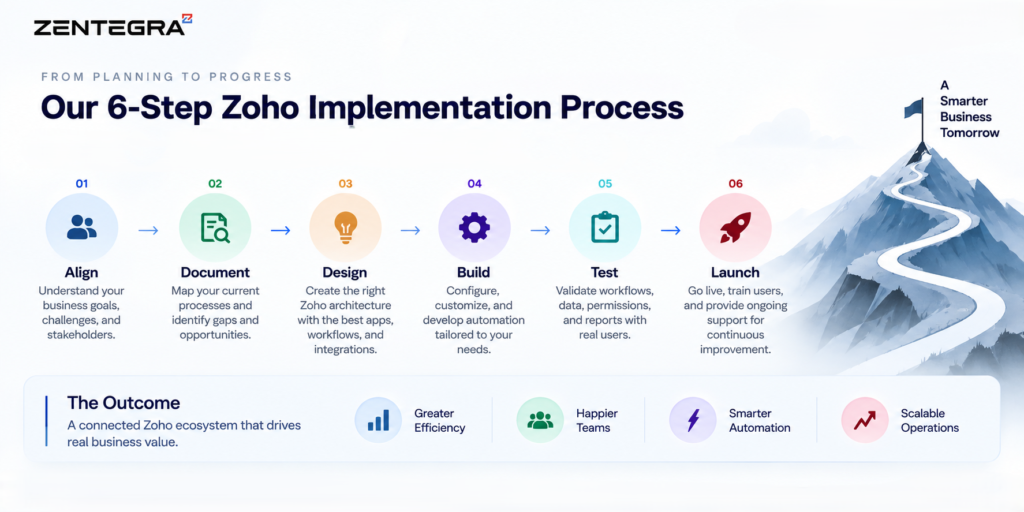
At Zentegra, the implementation process can be viewed as six connected phases:
Align → Document → Design → Build → Test → Launch
Align : Understand business objectives, departments, users, challenges, and expected outcomes.
Document : Map existing processes and identify gaps, dependencies, and opportunities for automation.
Design : Select the appropriate Zoho applications and design the system architecture, workflows, permissions, and integrations.
Build : Configure applications, create custom components, develop automation, and connect third-party systems.
Test : Test workflows, permissions, integrations, reports, and migrated data before users depend on the new system.
Launch : Train users, move into production, provide support, and identify opportunities for ongoing optimization.
This approach helps turn Zoho from a collection of applications into a connected business system. Businesses that need support beyond planning can also explore Zentegra’s Zoho implementation services for configuration, automation, integrations, migration, and deployment.
Zentegra’s public case studies also describe measurable outcomes from Zoho implementations, including improved financial visibility, standardized data, reduced manual accounting work, and stronger reporting.
When Does DIY Zoho Implementation Make Sense?
A partner is not necessary for every business.
DIY implementation may make sense when:
- You are using a single Zoho application.
- Your workflows are straightforward.
- You have clean and limited data.
- No complex integrations are required.
- Someone internally has enough technical knowledge.
- Your team has time to learn and test the platform.
Professional help becomes more useful when you have multiple applications, complex workflows, large historical datasets, custom development requirements, integrations, or strict reporting needs.
The right question is therefore not simply, “Can we implement Zoho ourselves?”
It is “What level of complexity can our team confidently manage without creating future rework?”
Final Thoughts
Zoho gives businesses a powerful ecosystem, but software alone does not create an effective operating system for your company.
The value of a Zoho Advanced Partner comes from combining platform knowledge with business process expertise. The right partner can help you decide what to implement, configure it correctly, automate repetitive work, migrate important data, train your team, and improve the system after launch.
DIY can be appropriate for simple requirements. But when your Zoho environment involves multiple teams, applications, integrations, automation, or historical data, professional implementation can reduce complexity and future rework.
For businesses evaluating Zoho, the goal should not simply be to get the software running. The goal should be to build a system that your people can use, your managers can understand, and your business can grow with.
Zentegra combines Zoho consulting, implementation, automation, migration, business advisory, and managed services to help businesses build a connected Zoho environment. If you’re evaluating whether DIY implementation is right for your business or need help planning your Zoho deployment, contact Zentegra to discuss your requirements and implementation goals.Zentegra combines Zoho consulting, implementation, automation, migration, business advisory, and managed services to help businesses build that connected environment.